What Bit Should I Use for My Horse? Why the Answer Isn’t Just About the Bit
“What bit should I use for my horse?” is probably one of the most common questions asked about bitting, and it’s completely understandable. Walk into a tack shop or start searching online and the choice can be overwhelming. Different mouthpieces, cheeks, materials, thicknesses and actions, all promising slightly different things.
The problem is that there isn’t one bit that is right for every horse, and choosing the right bit involves looking at far more than what’s sitting inside the horse’s mouth.
When I carry out a bit fitting, my aim is always to improve two things: comfort and clear communication between horse and rider. To do that properly, I need to look at the whole picture.
Of course, the horse’s mouth matters enormously. The anatomy of the mouth, tongue, bars and lips, the amount of space available, the size and position of the bit and how it sits within the mouth all form part of the assessment. A bit that suits one horse beautifully may be completely unsuitable for another, even if those horses appear very similar from the outside.
This is one of the reasons simply asking another rider what bit they use can send you down a very expensive rabbit hole. Their horse isn’t your horse.
Looking Beyond the Horse’s Mouth
Once we move on to the ridden assessment, the picture becomes much bigger. During an EBS fitting, the horse is always ridden in their usual bit first. This gives me a baseline and allows me to see their normal way of going before we start changing anything.
I’m looking at rhythm, balance, bend and flexion, transitions and acceptance of the contact. I’m looking at how easily communication is passing between horse and rider, how clearly the horse responds to the aids and whether achieving those responses is taking more effort than it should.
I’m also looking for the smaller signs. Does the horse soften through the neck and jaw when asked, or brace against the contact? Do they lean or become heavy? Do they come above the bit, tuck behind it or struggle to maintain a consistent contact? Are they opening the mouth, chomping excessively, putting the tongue out or attempting to put it over the bit? Is there tension through the face, jaw, poll or neck? Is the bit moving excessively in the mouth?
These behaviours can tell us a lot, but they have to be viewed in context. One behaviour on its own doesn’t automatically tell us that a horse dislikes its bit.
A horse opening its mouth doesn’t simply equal “wrong bit”, just as a horse putting its head up doesn’t automatically mean the bit is too strong. I want to see when the behaviour occurs, what the horse was being asked to do, what happened immediately beforehand and how the horse responded afterwards.
Sometimes the bit is contributing to the problem. Sometimes it isn’t.
A horse that ignores a rein aid isn’t necessarily uncomfortable in its mouth. A horse that becomes strong while hacking may simply be extremely excited, or may have learned that a particular stretch of grass is where they always canter. Changing to a stronger bit isn’t going to undo that learned behaviour.
In the arena, a horse described as “strong” might actually be leaning on the contact, bracing through the neck, ignoring an aid or not clearly understanding what is being asked. Equally, there are horses for whom a different action or stronger bit is entirely appropriate.
This is where professional bit fitting becomes much more than trying a selection of bits until one appears to work.
My aim isn’t simply to put a different bit in the horse’s mouth and hope it solves the problem. I’m trying to improve comfort and clear communication between horse and rider.
Does a Strong horse Need a Stronger Bit?
Sometimes that means using a softer bit. Sometimes we might change the mouthpiece, cheek, stability or action. Sometimes a stronger action is appropriate. “Stronger” has become something of a dirty word in the horse world, but stronger isn’t automatically bad, just as softer isn’t automatically kinder.
If a horse braces through the neck or jaw, for example, I may choose a bit that helps the rider encourage flexion and softness. The important part is that changing the equipment doesn’t happen in isolation. Where necessary, I’ll also help the rider understand how to use the bit effectively and how to encourage the response we’re looking for.
A bit can improve communication, but it cannot replace it. I can change your horse’s bit, but I can’t bit my way around a training problem.
The right bit can make communication considerably clearer. It can make an aid easier for the horse to understand and allow the rider to use less effort, but it can’t replace the basic education of horse and rider.
How do I know if my horse is uncomfortable in their bit?
This is another question I’m asked regularly, and again, there isn’t one single sign that gives us the answer.
Possible signs can include bracing through the jaw or neck, becoming heavy in the contact, consistently going above or behind the bit, opening the mouth, excessive chomping, putting the tongue out or over the bit, reluctance to be bridled, tension through the head and neck or generally trying to evade the contact.
The important word there is “possible”. We need to establish why the behaviour is happening rather than assuming the bit is responsible.
This is exactly why a ridden assessment is so useful. Instead of guessing from one symptom, we can look at when it occurs, how the horse responds to different aids and what happens when we alter the fit, stability, mouthpiece or action of the bit.
How do I know when we’ve found the right bit?
Quite often, the horse tells us very quickly.
We may see the neck and jaw soften, less tension through the face, a quieter and more consistent contact, easier transitions and clearer responses to the aids. Importantly, the rider usually feels the difference too. They may find they don’t need as much hand, the horse responds sooner or something they’ve previously had to work hard to achieve suddenly feels much easier.
That is what I’m looking for during a fitting. I’m not simply looking for a horse that appears to go nicely in a particular bit. I want the horse to be comfortable and the communication between horse and rider to become easier and clearer.
There is also no universally “kind” bit. A mild-looking bit isn’t automatically kind, a stronger-looking bit isn’t automatically harsh and a fashionable mouthpiece isn’t automatically comfortable. The design of the bit matters, but so do the individual horse’s anatomy, way of going, level of training, discipline and the way the bit is being used.
So, if you’re currently asking “What bit should I use for my horse?”, my answer is that we need to look at your horse first.
If something doesn’t feel quite right, your horse has become stronger or less responsive, you’re struggling with the contact, you’re seeing mouth evasions, you’ve accumulated a drawer full of bits that haven’t solved the problem, or you simply want to know whether your horse could be more comfortable, an individual bit fitting gives us the opportunity to work out what’s actually happening rather than guessing.
EBS bit fitting appointments assess your horse’s mouth, current bit, way of going and the whole ridden partnership. We can then trial appropriate alternatives and assess the changes as they happen, with the aim of finding a solution that makes riding more comfortable, clearer and easier for both horse and rider.
For owners who want to understand more about bitting, the EBS Bitting Guides are also available on the website and cover many of the questions I regularly get asked. They’re a useful resource if you’d like to understand the subject in more depth, but if you’re having an individual problem with your own horse, don’t spend months trying bits at random. That’s exactly what a professional fitting is there to help with.
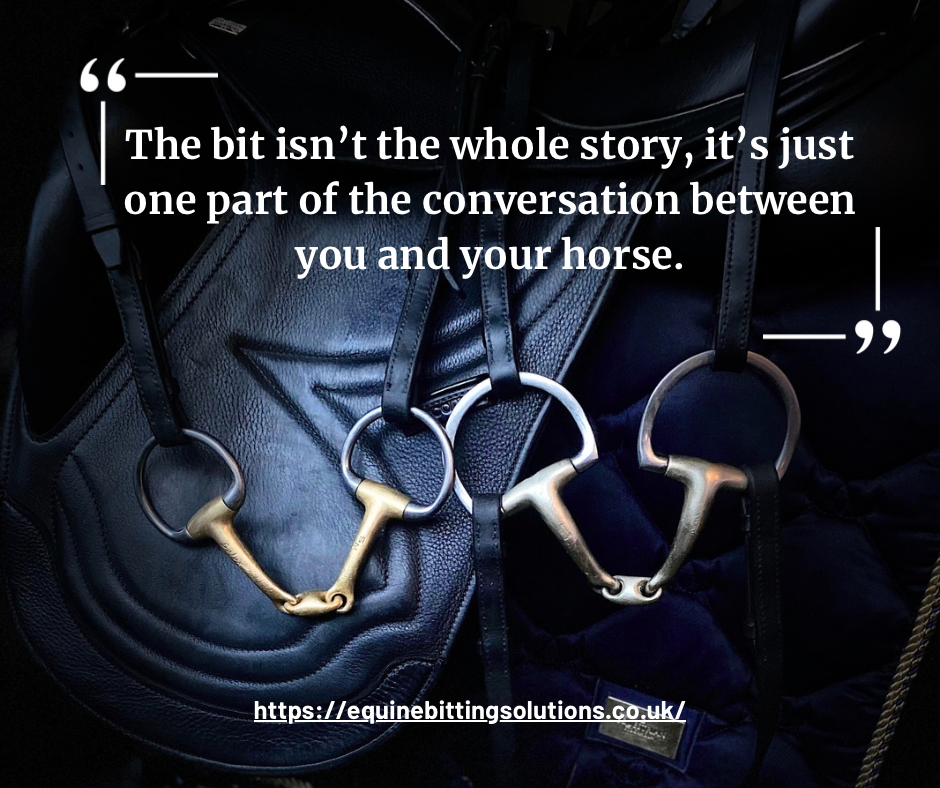
There is no magic mouthpiece and no single bitting solution that suits every horse. Horses are individuals, riders are individuals and the way those two communicate together is individual too.
That’s why, when I’m fitting a bit, I’m never just looking at what’s in the horse’s mouth. I’m looking at the whole picture and asking whether we can make things more comfortable, clearer and easier for both horse and rider.
Because ultimately, that’s what good bitting should achieve: comfort, clear communication, a happier horse and happier riding.
If you’re unsure whether your horse is comfortable in their current bit, or you’re struggling to find the right bitting solution, get in touch with EBS to book a professional bit fitting.